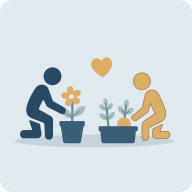
Garden Post is an educational and grant program of the Poczta Polska Group Foundation, the aim of which is to create green spaces in workplaces and build environmental awareness among employees.
The program is based on the belief that the presence of plants is important not only for the environment but also for the quality of the spaces we inhabit every day. Greenery influences the environment, supports air quality, and helps create more people-friendly spaces. Growing vegetables and herbs allows us to better understand the value of food and the journey it takes before reaching our tables. Garden Post demonstrates that contact with nature can be a part of everyday life, even in the workplace.
Two types of Garden Post Offices are being created as part of the program.
Garden Flower Mailboxes are made of flowers and plants that increase the presence of greenery in the workplace and influence the quality of the daily environment of employees.
The Garden Vegetable Post Offices are made of vegetables and herbs grown in pots. They demonstrate that even a small space can become a place for growing plants, gaining knowledge, and building greater awareness about food.
The program combines education with action, and its results are sustainable green spaces created by teams of Poczta Polska Group employees.
Ogrodowa Poczta shows that caring for the environment begins with knowledge, awareness and everyday choices.
The program encourages us to look at the world around us through the prism of four areas that are fundamental to life and the environment: water, food, air and plants.
The knowledge gained is then applied in practical activities undertaken by program participants. The result is the Garden Post Offices – green spaces created collaboratively by employees.
The program consists of an educational part and a grant competition.
The basis of the program is the educational part available to all participants from August 3, 2026.
The prepared educational material will be available for download from the program's website. The study presents key environmental challenges related to water, food, air, and plants, and demonstrates how everyday decisions impact the world around us.
After reviewing the materials, participants complete a 20-question quiz—five questions from each area. Completing the educational portion is a requirement for participation in the grant competition.
Water is one of the most valuable natural resources. For many years, Poland has been among the countries with the smallest water resources in Europe. Per capita, there are approximately 1,600 m³ of renewable water resources per year, while the European average is several times higher.
Climate change is causing increasingly frequent droughts, making responsible water management one of the most important environmental challenges. The educational material highlights the importance of water retention, water conservation, and the impact of daily habits on water conservation.
According to the Food and Agriculture Organization of the United Nations, approximately one-third of the food produced globally is lost or wasted. This translates to approximately 1.3 billion tons of food lost annually.
Behind every food product are natural resources: energy, soil, and water used to produce it. This educational material demonstrates how to reduce food waste, plan purchases consciously, and better understand the relationship between food and the environment.Air quality has a direct impact on health and quality of life. According to the World Health Organization, air pollution remains one of the greatest environmental threats to human health.
The educational material explains the sources of pollution, its impact on the human body, and the importance of greenery in creating a more welcoming environment. Participants will also learn about the role of plants in shaping the spaces in which we live and work.
Plants are the foundation of healthy ecosystems. They support biodiversity, help retain water, mitigate the effects of high temperatures, and influence the quality of the spaces around us.
A growing body of research also points to the importance of greenery for everyday comfort. Educational material demonstrates why the presence of plants is important both for the environment and for quality of life.
Teams of Poczta Polska Group employees can join the program.
The condition for submitting a grant application is completing the educational part and completing the quiz.
Grants are awarded in two categories.
Garden Flower Mail
The project involves creating green spaces using flowers and plants.
The goal is to increase the presence of greenery in workplaces and create spaces that foster daily contact with nature. Plants improve the quality of the surroundings, support air quality, and help create a more pleasant work environment.
Garden Vegetable Mail
The project involves the creation of small vegetable and herb crops in pots and other solutions adapted to the capabilities of a given facility or organizational unit.
The aim is to develop knowledge about food, its origins and importance for the environment, and to show that growing vegetables and herbs can be part of everyday life even in the workplace.
Schedule
September 25, 2026.
Educational materials available.
October 9 – October 30, 2026.
Submission of grant applications.
November 19, 2026
Announcement of grant competition results.
December 2026.
Concluding grant agreements
January 2027.
Payment of grants.
March 2027 - June 2027.
Implementation of projects in the Garden Flower Mail.
Implementation of projects in the Garden Vegetable Mail
The Foundation's grant competitions are conducted through the "Telegram of Passion" program. In an edition dedicated to the "Garden Mail" program, we will publish documents related to the program in the second half of September 2026.


