
Gdańsk postal workers are an example of heroism and sacrifice
 The sentence on 38 Polish postal workers was carried out at dawn on October 5, 1939, in the Zaspa district of Gdańsk. They were led away shackled. After being shot, their bodies were buried in a common grave and covered with slaked lime. The crime scene remained unknown for another 50 years. The story of the defense of the Polish Post Office in Gdańsk is one of the most tragic in the history of our country. On the 80th anniversary of those dramatic events, the Polish Post Office issued a stamp commemorating the postal workers who resisted the Germans.
On September 1, 1939, at 4:45 a.m., concurrently with the shelling of Westerplatte, the Germans attacked the Gdańsk 1 Post Office. First, the Germans detonated the wall of the nearby National Employment Office. However, the postal workers managed to repel their attack, taking the invaders completely by surprise. In response, the Post Office premises were cordoned off from the rest of the city.
During the attack, 43 postal workers from Gdańsk, 10 postal workers delegated from Bydgoszcz, and one Gdańsk railway worker were inside the building. The overwhelming numerical and military superiority of the German aggressors left the office's defenders with little chance of victory. However, they bravely defended themselves. After a full day of fighting, their situation was dire. They were wounded, cut off from the world, running out of ammunition, and without electricity or water. Thick smoke and fire made visibility and breathing difficult. Heavy fire forced them to descend to the basement.
After 14 hours of fighting, the final phase of this tragedy began. The Germans pumped gasoline into the building's basement and threw a grenade inside. The fate of the defenders was effectively sealed. During the clashes, 13 postal workers were killed and 10 seriously wounded. The main commanders of the Gdańsk resistance were Karol Guderski and, after his death, Alfons Flisykowski.
After the surrender of the Gdańsk 1 Post Office, the Germans decided to place the surviving defenders of the Post Office in a detention center, which they set up in the building of the Gdańsk Victoriaschule high school for girls. A week after the invasion of Poland, on September 8, 1939, the Germans organized a trial of the postal workers. A court martial under Wehrmacht General Georg Eberhardt sentenced 28 defenders of the Post Office to death. On September 30, the same sentence was handed down to the remaining 10 postal workers. The legal basis for the verdict was a provision of the special war criminal law of 1938. Under this law, the defenders of the Post Office were recognized as partisans and sentenced to death by shooting. The sentences were issued by the court martial president, Kurt Bode, and confirmed by the Supreme Commander of the Wehrmacht Army, Walther von Brauchitsch.
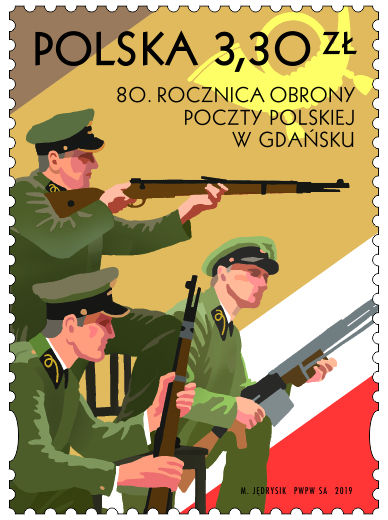
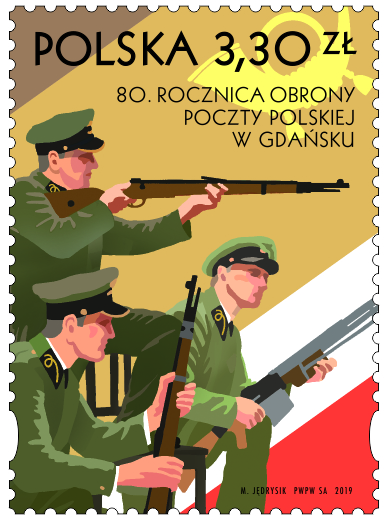
On September 1, a philatelic publication commemorating the heroic struggle in the first hours of the war will be released. Designer Maciej Jędrysik depicted three armed Polish Post employees in uniform on the stamp. Along the top edge are the inscription POLAND, the value of PLN 3.30, and the issue theme: 80TH ANNIVERSARY OF THE DEFENSE OF THE POLISH POST IN GDAŃSK, with the historic Polish Post logo featuring a trumpet in the background.
About the stamp:
stamp designer: Maciej Jędrysik
number of stamps: 1
value: PLN 3.30
circulation: 216,000 pcs
printing technique: offset
stamp format: 31.25 x 43 mm
sales sheet: 12 stamps
paper: fluorescent
date of introduction into circulation: September 1, 2019
This and other philatelic publications of Poczta Polska can be purchased at post offices and online store: www.filatelistyka.poczta-polska.pl .