
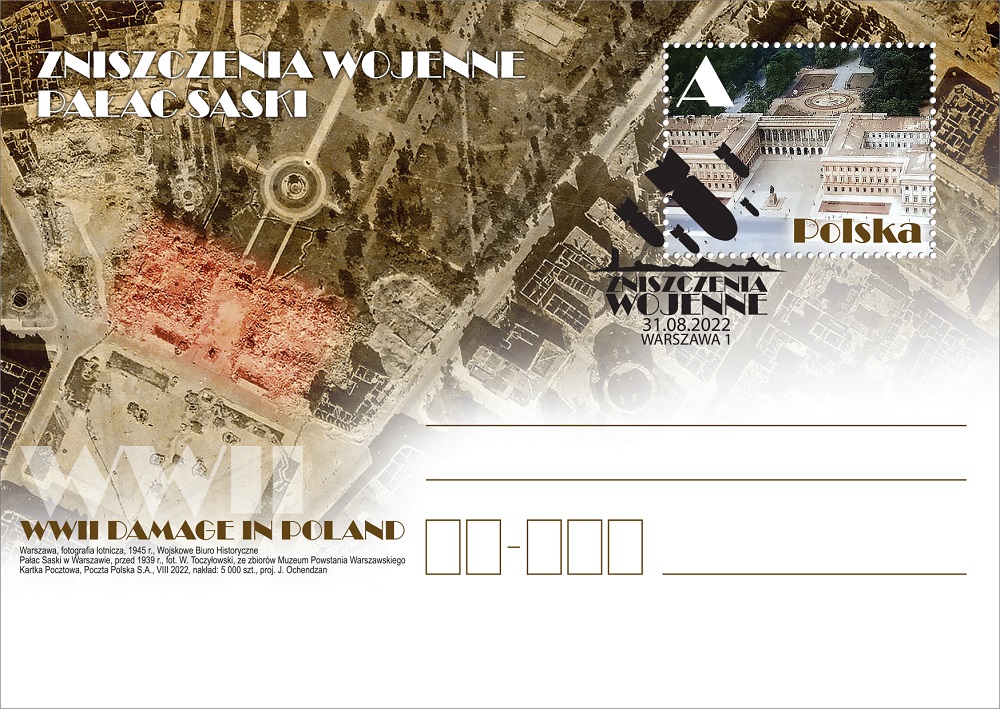
The new philatelic series of the Polish Post "War Damage"
 Poczta Polska is launching a new philatelic series, "War Damage." The first in the series is the Saxon Palace, which appears on a postage stamp. The company introduced it into circulation on August 31st of this year.
The publisher's author, Jarosław Ochendzan, placed an image of the Saxon Palace building from before 1939 in the postcard's payment area. The illustrations include an aerial photograph of the ruins of the Saxon Palace and Saxon Garden in Warsaw from 1945. A date stamp with a graphic of symbolic bombs falling on the city complements the postcard's design. The postcard's design utilized photographs from the resources of the Military Historical Bureau and the Warsaw Uprising Museum. Polish Post was supported by the Central Military Library, the Military Historical Bureau, the Saxon Palace Ltd., and the Warsaw Uprising Museum.
The postcard was presented on September 2nd at the Polish Post headquarters. The ceremony was attended by Deputy Prime Minister and Minister of State Assets Jacek Sasin, Secretary of State at the Ministry of State Assets Jan Kanthak, Acting President of the Management Board of the Polish Post Krzysztof Falkowski, Vice President of the Management Board of the Polish Post Wiesław Włodek, Vice President of the Polish Post Mateusz Wodejko, Vice President of the Institute of National Remembrance Karol Polejowski, President of the Polish Security Printing Works Maciej Biernat, and President of the Saxon Palace Company Jan Edmund Kowalski.
" Through the new philatelic series, 'War Damage,' Poczta Polska is recalling the enormous losses suffered by Warsaw and Poland as a result of German aggression. This is the best way to make the younger generation aware of the events we must never forget. The inclusion of the Saxon Palace on the first page of the series is undoubtedly symbolic, as for many, the history of this building symbolizes the tragic fate of Warsaw after the fall of the Warsaw Uprising. On December 29, 1944, the palace's over 300-year history was destroyed by German Sprengkommando units who blew up selected buildings of particular historical and cultural significance. For many years after the war, the topic of rebuilding the Saxon Palace was absent from public debate. The idea of restoring the buildings on Piłsudski Square to their former glory was revived during the mayoralty of Warsaw, the late Lech Kaczyński, who made it one of the focal points of his term." The decision to begin the investment to reconstruct the buildings on the western frontage of Piłsudski Square gives hope that the topography of Warsaw will not be determined by the vandalism of the German occupiers, and the Saxon Palace will become a symbol crowning the work of rebuilding the post-war capital , noted Jacek Sasin, Deputy Prime Minister, Minister of State Assets.
" During the five years of World War II, Warsaw became a sea of ruins and a vast cemetery. Of course, wartime destruction affected the entire country, but Warsaw is the city most "tormented." Therefore, when launching a new series of postcards, we decided to feature the Saxon Palace as a symbol of the ruined city. Miraculously preserved, the Tomb of the Unknown Soldier is now the beginning of the reconstruction of one of the capital's most impressive palaces and monuments. I hope that our card, showcasing the monument's former splendor and what the German occupiers left behind, will convince those still unconvinced that it is worth investing in the reconstruction of these jewels of our former glory, " says Krzysztof Falkowski, Acting President of the Management Board of Poczta Polska.
As a result of German air raids and artillery fire in September 1939, Warsaw lost approximately 15 percent of its left-bank development. Bridges, railway lines, power plants, and food depots were destroyed. During the occupation, the Germans deliberately prevented the reconstruction of the urban fabric to humiliate the Poles and kill their fighting spirit. The Warsaw Ghetto Uprising in 1943 and the Warsaw Uprising in 1944 sealed the fate of the capital. The Germans systematically destroyed the capital, burning and blowing up building after building. The Old Town and Muranów were completely razed to the ground. The Team to Establish the Value of Losses Suffered by Warsaw as a Result of World War II, appointed in 2004 by Warsaw Mayor Lech Kaczyński, estimated the total material losses suffered by Warsaw and its residents at 18.2 billion złoty, equivalent to over six times the budgets of pre-war Poland. It is also said that the approximate amount of rubble covering Warsaw in 1945 reached 20 million cubic meters. The Saxon Palace, one of the city's many landmarks, was razed to the ground. The Germans successively dynamited it from December 27 to 29, 1944. Miraculously, only a section of the arcades with the Tomb of the Unknown Soldier survived.
About the card:
card design author: Jarosław Ochendzan
number of cards: 1
value: A
circulation: 5,000 pcs
printing technique: offset
card format: 148 x 105 mm
date of introduction into circulation: August 31, 2022