
Polish Post warns against another attack by cybercriminals
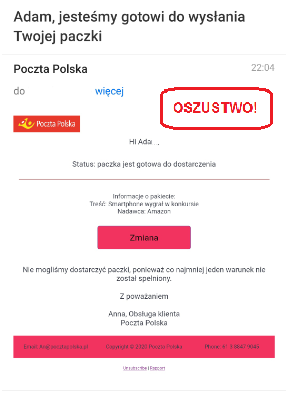
Once again, cybercriminals are impersonating the Polish Post Office. In order to obtain personal information or money, they are sending fraudulent emails using the company's logo and name. The Polish Post Office informs us what to watch out for and what the general rules are to protect against email scams.
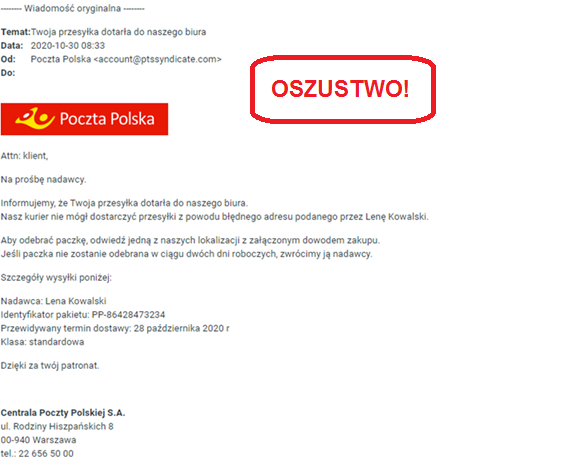
One attack involves sending fake emails informing of a misdirected shipment. These emails contain an attachment containing malware, a so-called Trojan. Another method used by cybercriminals is sending fake emails claiming to have won a new smartphone in a contest. Cybercriminals inform users that to receive the prize, simply click a link, which redirects them to a fraudulent website designed to extort data and money. The company has already reported this incident to the Computer Security Incident Response Team (CSIRT GOV).

" We would like to inform you that Poczta Polska is not the initiator of these email campaigns. Please be vigilant and carefully read any messages you receive and the links they contain, " says Justyna Siwek, spokesperson for Poczta Polska. " If you receive suspicious messages or suspect irregularities or discrepancies, please report the matter to the police and immediately inform us at cyberbezpieczenstwo[at]poczta-polska.pl . This will allow us to warn our customers and block the fraudulent website, " urges Justyna Siwek.
What information does Poczta Polska send?
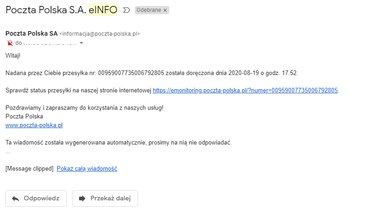
Poczta Polska sends emails about shipments from the address informacja@poczta-polska.pl , which are for informational purposes only, as seen in the screenshot below. The company provides information on where to find information about the current status of the shipment and openly directs customers to the Poczta Polska website https://emonitoring.poczta-polska.pl, where our customers can check the current stage of their shipment's journey.
What is phishing
Phishing is a method of online fraud. It aims to extort sensitive data from users, such as passwords, logins, addresses, PESEL numbers, bank account numbers, and credit card numbers. It involves impersonating well-known, often government, institutions, such as the tax office, ministries, or the Social Insurance Institution (ZUS). Messages are crafted to resemble a potential letter from the entity they claim to be.
These types of emails rely on social engineering—they typically encourage users to click on an attached link or download a file (in reality infected with a computer virus). This is done with a false promotional offer or a supposed warning about unsettled payment methods.
8 rules to avoid phishing – vigilance is key!
- Always have limited confidence in the messages you receive.
- Do not open attachments unless you were expecting a message from the sender.
- If you don't know the sender, think very carefully before opening the message.
- Do not transmit your data (sensitive, confidential) in an open message without security.
- Carefully check any links contained in the message you receive or posted on the website.
- Always update your email program and web browser.
- Install add-ons for your email client or browser that increase their security.
- Always install add-ons from original suppliers, recommended by the manufacturers of the software.
The increased practice of email impersonation of Poczta Polska has occurred several times. We would also like to inform you that Poczta Polska is not responsible for the consequences of actions taken by customers in messages distributed by other entities, including entities impersonating Poczta Polska.