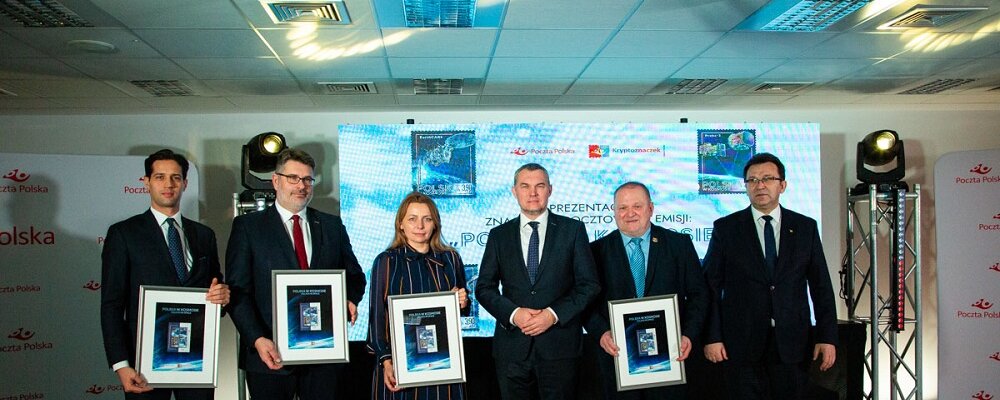
The Polish Post Office is introducing "Poland in Space" stamps. This heralds next year's series of crypto stamps.
"Poland in Space" is an issue of four traditional stamps. Each one is dedicated to missions within international projects to which Polish scientists contributed. This issue will be released early next year as crypto-stamps of Poczta Polska.
In October 2022, Poczta Polska launched a website: nft.poczta-polska.pl, where it offers digital collectibles. The first Polish "Poland in Space" crypto stamps are scheduled for issuance in the first quarter of 2023, but they were already released in their traditional form on December 6th of this year. Roch Stefaniak designed all the stamps, based on graphics by Bartosz Morawski.
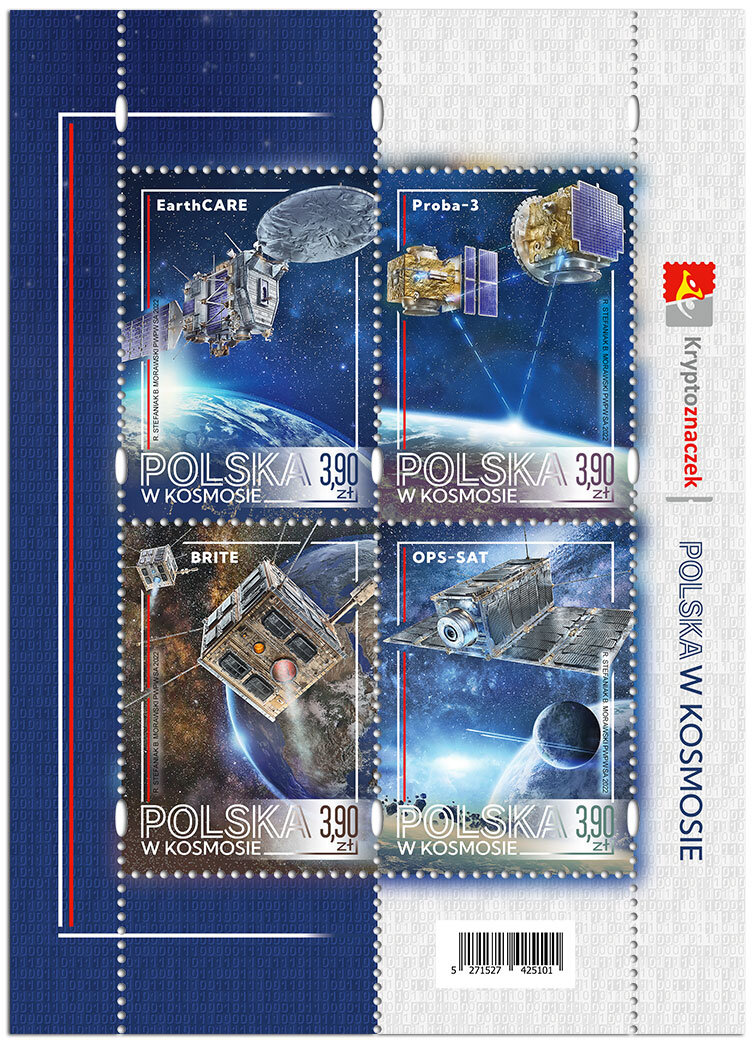
The issue consists of four stamps – each of them is dedicated to missions within international projects to which Polish scientists contributed.
The first stamp is about EarthCARE, an Earth observation mission organized by the European Space Agency (ESA) in cooperation with the Japan Aerospace Exploration Agency (JAXA) and the Japanese National Institute of Information and Communications Technology (NICT).
The second stamp shows the satellites: Lem (launched on November 21, 2013) and Heweliusz (launched on August 19, 2014). The BRITE-PL mission is part of a Canadian-Austrian-Polish project.
The third stamp is dedicated to the European Space Agency's PROBA program. It demonstrates technologies for satellite platforms and payloads.
The fourth stamp depicts the OPS-SAT space components, the first mission of the European Satellite Operations Centre (ESOC) to be operated on a CubeSat satellite. Its primary goal is to test new standards for data exchange between the satellite and the ground segment. Polish experts are responsible for developing all the mission's onboard software, control and fault detection systems, implementing the new data exchange standard, and one of OPS-SAT's two key payloads – the CCSDS protocol converter. This mission was launched in December 2019.
The graphics used in the traditional version of the stamps will also appear on crypto stamps, scheduled for sale in the first quarter of 2023. Each crypto stamp consists of two parts: one is a traditional postage stamp, and the other is unique NFT tokens on the Polygon network using the ERC1155 standard, which enables the handling of multiple token types within a single application in a blockchain environment. The Polish Crypto Stamp system is not only a combination of traditional postage stamps and cryptographic technologies, but also a comprehensive environment building a digital philatelic community in Poland and worldwide.
The author of the creation and implementation of the crypto stamp collection concept is Dariusz Tyszka.
"Poczta Polska is a company that most Poles associate with tradition and a rich, nearly five-century-long history. However, the national postal operator is constantly evolving, adapting its operations to the realities of a digitalizing world. Thanks to intensive modernization processes, we can offer our customers increasingly high-quality solutions. We also remember philatelists and those passionate about technological innovations. Our consistent and multi-vector approach to modernity is reflected in crypto stamps, which are already generating enormous interest. It is thanks to this ambitious project that we can engage young people in the beautiful passion that philately undoubtedly is, " said Krzysztof Falkowski, President of Poczta Polska.
The partners of the issue are: the Polish Space Agency and the Polish Security Printing Works.
Poczta Polska will systematically present its digital collecting offerings on its website: nft.poczta-polska.pl. Physical versions of crypto-philatelic stamps will be available for purchase at selected post offices and on the website www.filatelistyka.poczta-polska.pl .
About stamps:
stamp designer: Roch Stefaniak
number of stamps: 4
value: PLN 3.90 each
circulation: 100,000 blocks
printing technique: offset
stamp format: 31.25 x 43 mm
paper: fluorescent
sales sheet: 4 stamps
date of introduction into circulation: December 6, 2022