
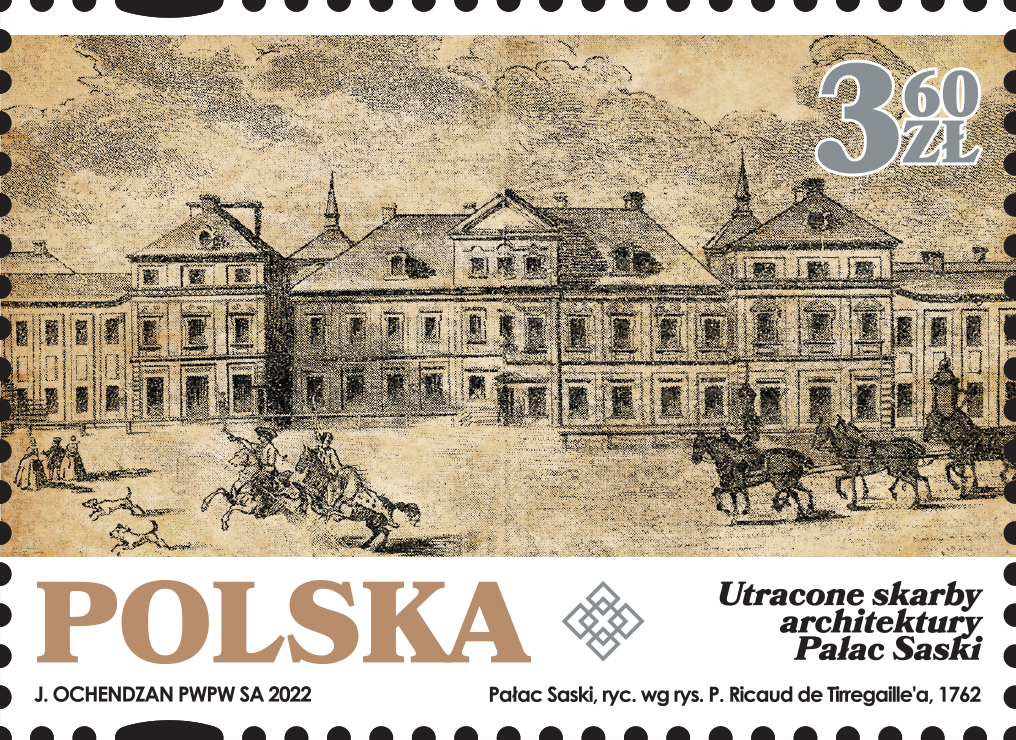
The Polish Post Office has issued "Lost Architectural Treasures" stamps
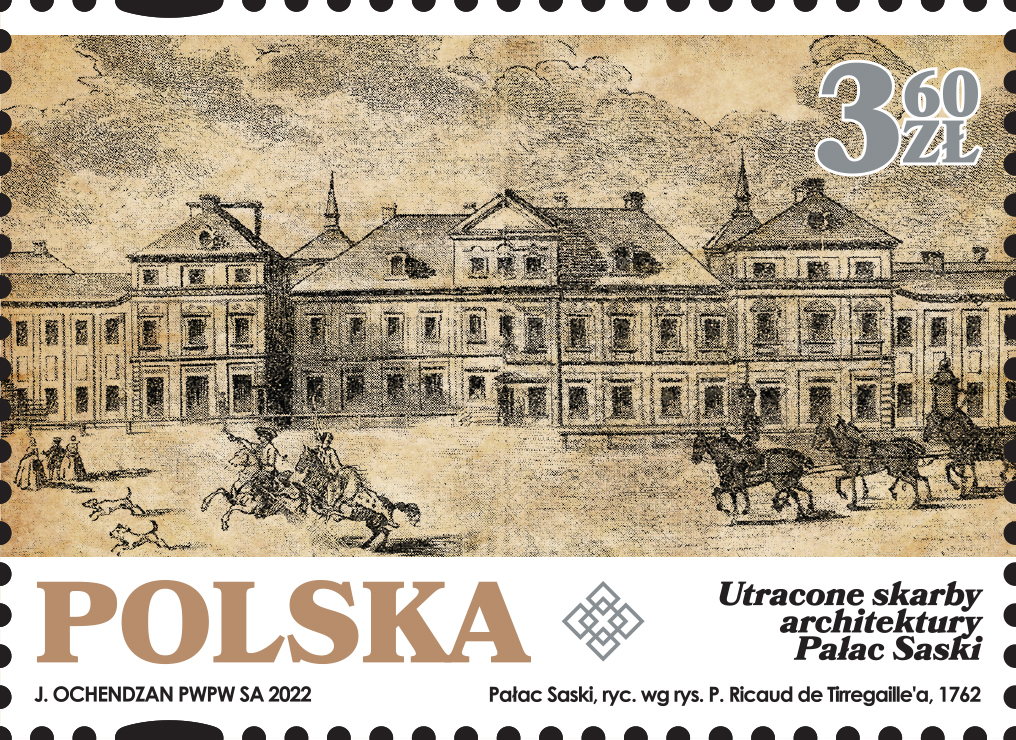 On June 30, 2022, two stamps were released in the "Lost Architectural Treasures" series, depicting the Myszkowski Castle in Pińczów and the Saxon Palace in Warsaw.
The aim of the issue is to showcase lost, unique architectural structures of exceptional significance to Poland's history and cultural heritage. The first stamp, designed by Jarosław Ochendzan, depicts Myszkowski Castle in Pińczów in an engraving based on a drawing by Eric Dahlbergh from 1696. The second stamp depicts the Saxon Palace in Warsaw in an engraving based on a drawing by Pierre Ricaud de Tirregaille from 1762. The creator intended both stamps to showcase the historic buildings in their heyday, before their reconstruction. At the same time, these are the only currently available surviving images of both structures. The issue was created in close collaboration with the Regional Museum in Pińczów and the Saxon Palace company.
In the 15th century, the Pińczów Castle complex was the most magnificent magnate residence in Lesser Poland. It was characterized by exceptional architecture, and its reconstruction was led by Santi Gucci, architect and court sculptor to Anna Jagiellon and Stefan Batory. The Pińczów Castle ceased to exist at the end of the 18th century.
The Saxon Palace stood in Warsaw for almost 300 years, but underwent several transformations until it was blown up in 1944 by the German occupiers. The only surviving fragment of the Saxon Palace is the Tomb of the Unknown Soldier. Built in the second half of the 17th century, Jan Andrzej Morsztyn, then a politician and now known as a poet, obtained permission from the king to build a Baroque palace. The building was designed either by Tylman van Gameren or by Giovanni Battista Gisleni, architect of the Vasa dynasty. In 1713, Morsztyn's daughter sold the estate to Augustus II the Strong, who undertook a thorough renovation of the palace, intending to create a royal residence modeled on Versailles, with a representative square and magnificent garden. The palace, then called the Saxon Palace, was the central element of the urban development known as the Saxon Axis. The expansion of the complex was continued by the ruler's son, heir to the throne, Augustus III the Saxon. The reign of Augustus III was a time of splendour for the Saxon Palace, which was joined by the adjacent Brühl Palace and Bishop Potocki's residence. However, this golden age ended with the king's death in 1763. In 1837, the Saxon Palace was purchased by the Russian Jan Skwarcow, who commissioned a thorough renovation. The building was constructed in the Classicist style, designed by Adam Idźkowski, who created the Saxon Palace in its most famous form – replacing the central section of the complex with a distinctive Corinthian colonnade.
By issuing the "Lost Cultural Treasures" series, Poczta Polska SA wants to present works related to Poland's cultural and historical heritage on stamps, while also promoting the planned revitalization works of the most valuable national heritage sites in Poland.
About stamps:
Designer: Jarosław Ochendzan
Number of stamps: 2
Value: PLN 3.60
Circulation: 180,000 pcs.
Printing technique: offset
Stamp format: 43 x 31.25 mm
Paper: fluorescent
Sales sheet: 8 stamps
Date of introduction into circulation: June 30, 2022