
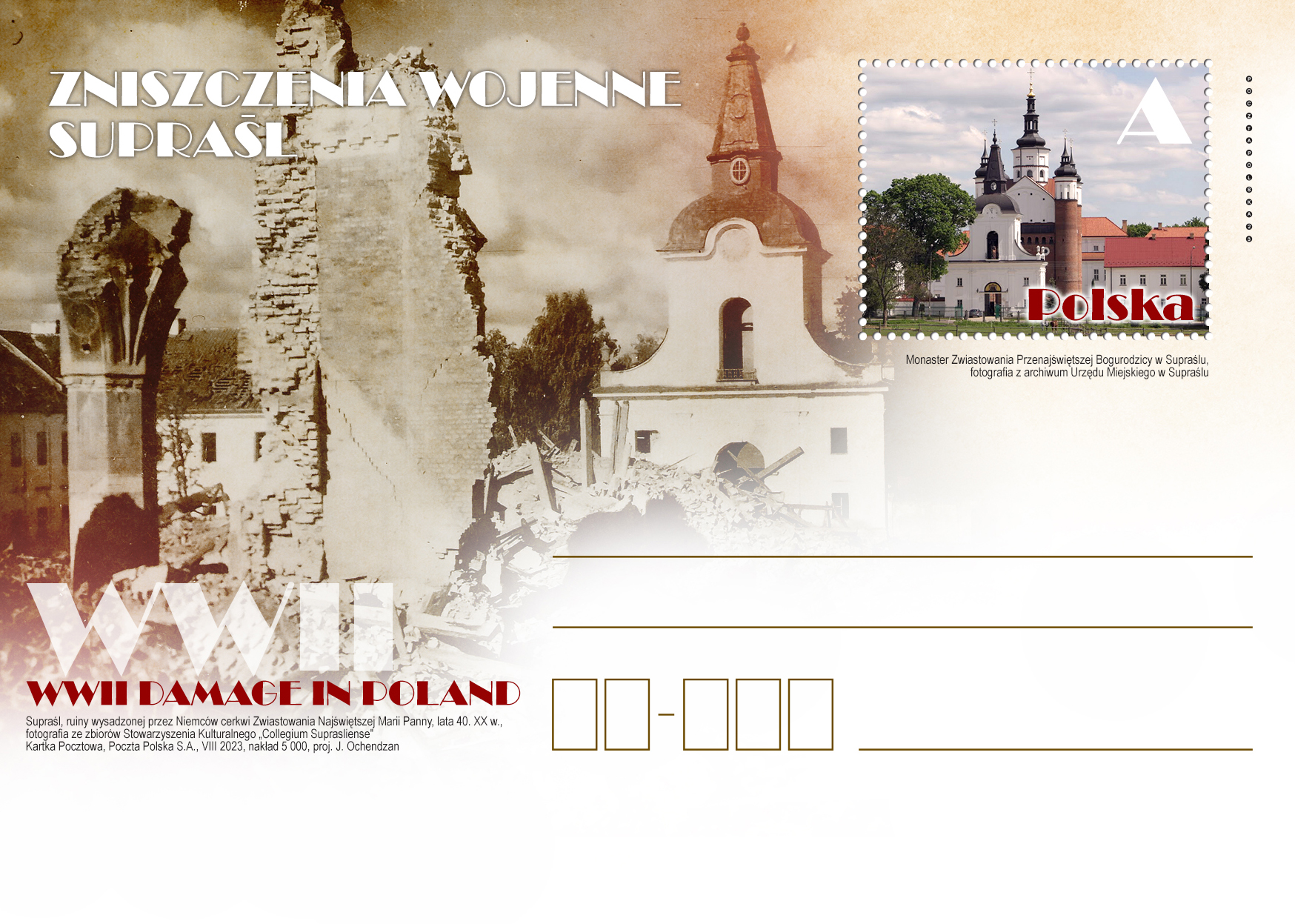
The Podlasie monastery on a new card. The Polish Post has issued the second philatelic item from the "War Damage" issue.
 The Polish Post Office continues its philatelic issue dedicated to the theme of wartime devastation. This time, a new postcard features one of the most valuable treasures of the Podlasie region – the Monastery of the Annunciation of the Most Holy Mother of God and St. John the Theologian. The postcard was unveiled on September 12th at the Museum of Icons in Supraśl.
The ceremonial presentation of the postcard bearing the "War Damage" stamp took place at the Monastery of the Annunciation of the Most Holy Mother of God. The event was attended by, among others, Jacek Sasin, Minister of State Assets; Mariusz Gromko, Senator of the Republic of Poland; Artur Kosicki, Marshal of the Podlaskie Voivodeship ; Father Archimandrite Dr. Sergiusz (Matwiejczuk); Radosław Dobrowolski, Mayor of the Supraśl Commune; Krzysztof Falkowski, President of Poczta Polska; and Wojciech Krysztofik and Wiesław Włodek, Vice Presidents of Poczta Polska.
The author of the publication, Jarosław Ochendzan, placed an image of the Monastery of the Annunciation of the Blessed Virgin Mary in Supraśl in the payment area of the postcard. The illustrative section of the postcard featured a photograph of the ruins of the Church of the Annunciation of the Blessed Virgin Mary in Supraśl, which was blown up by the Germans during World War II. The design of the postcard utilized photographs from the collections of the Cultural Association, the Collegium Suprasliense, and the Supraśl Municipal Office.
The war history of the present monastery in Supraśl
During World War II, Supraśl suffered from two occupiers. The Germans entered the city in mid-September 1939, and just a week later, the Soviets occupied the city. They converted the buildings of the historic Basilian monastery into barracks and destroyed the church's furnishings, including a unique 17th-century iconostasis. The palaces of local industrialists – the Zachert and Buchholtz families – were robbed of valuable books, furniture, and paintings, which were taken deep into the USSR. After the outbreak of the Soviet-German war, the Russians burned the historic Abbots' Palace from the mid-17th century – part of the current Monastery of the Annunciation of the Most Holy Theotokos and St. John the Theologian.
The Germans, who occupied Supraśl from the summer of 1941 to the summer of 1944, inflicted further destruction on the town, including by blowing up the synagogue. This was a prelude to the extermination of the Jewish population, which ultimately ended in 1942 when they were deported to the Białystok ghetto and from there to the Treblinka extermination camp. In 1944, faced with the approaching front, the occupiers employed a scorched-earth policy, destroying almost all of Supraśl's factories, the sawmill, and the bridge over the river. On July 23, 1944, they blew up the town's symbol – the historic Orthodox church. After the Germans left, the Red Army once again barracked in Supraśl. They destroyed the interiors of the Buchholtz Palace, the Evangelical Church, and the People's House, as well as many residential buildings.
The Monastery of the Annunciation of the Most Holy Theotokos and St. John the Theologian was built between 1503 and 1510 in the Gothic-Byzantine style. The structure was built in the Suchy Hrud forest at the initiative of its principal benefactor, Aleksander Chodkiewicz, Voivode of Nowogródek. Reconstruction and conservation work began shortly after the end of the war and lasted for several decades. In the 1980s, reconstruction of the church began, completing in 2021 with a ceremonial consecration of the restored church.
Currently, the over 500-year-old Orthodox male monastery in Supraśl, known as the Supraśl Lavra, is one of the most important centers of monastic life in Poland. It played a significant role in the history of the Polish-Lithuanian Commonwealth as a center of spirituality, education, and culture. Outstanding iconographic and musical works were created here. It was here that the 11th-century manuscript known as the Supraśl Codex was discovered, a unique monument of Old Church Slavonic writing.
The first issue dedicated to the destruction of war
In August 2022, Poczta Polska launched a new philatelic series, "War Damage." The first in the series was the Saxon Palace, which appeared on a postage stamp.
Designer Jarosław Ochendzan showed in the postcard payment field an image of the Saxon Palace building in its pre-war state, dated before 1939. The illustration section of the card also included a photo of the ruins of the Saxon Palace and Saxon Garden in Warsaw from 1945. The issue was complemented by a date stamp with a graphic of symbolic bombs falling on the city.
The postcard design utilizes photographs from the resources of the Military Historical Office and the Warsaw Uprising Museum. Polish Post was supported in the design process by the Central Military Library, the Military Historical Office, the Saxon Palace, and the Warsaw Uprising Museum.
The initiator of the "War Damage" issue project is the Minister of State Assets, Jacek Sasin.
About the card:
card design author: Jarosław Ochendzan
number of cards: 1
value: A
circulation: 5,000 pcs
printing technique: offset
card format: 148 x 105 mm
circulation date: August 31, 2023