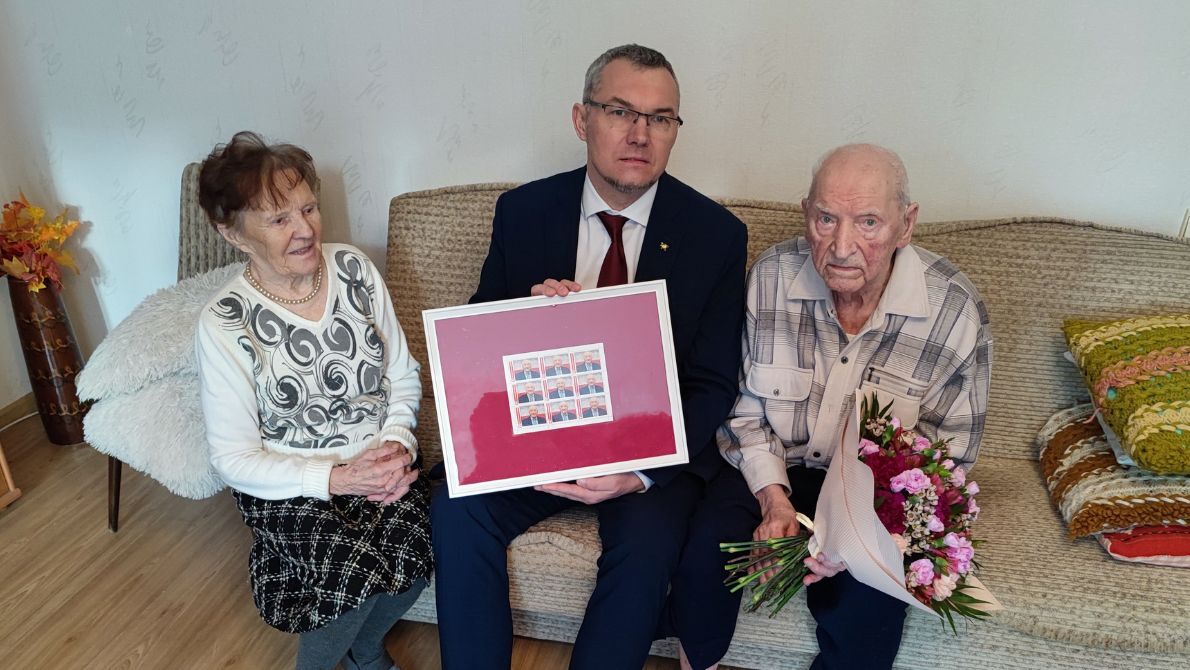
The President of Poczta Polska visited a 102-year-old former postman and "Unbroken Soldier"
On Monday, January 30, Krzysztof Falkowski, President of the Company, paid a visit to an extraordinary Postman. Lieutenant Colonel Kazimierz Szostakowski-Kobelis, a former Postal Employee and Cursed Soldier, has turned 102 years old. The Postman, who had rendered great service to the country, also received an extraordinary gift. The President of Poczta Polska recognized the Hero's life story by presenting him with a commemorative medal bearing the image of Sigismund Augustus II, founder of Poczta Polska.
"Your biography is a fine example of a Polish patriot, and your service to our homeland, including through postal work, deserves the highest recognition. As Postal Workers, we are very proud that you were our employee. We wish you good health and well-being, allowing you to share your memories with younger generations who need true role models. People like you are role models for all times," said Krzysztof Falkowski, President of Poczta Polska.
Mr. Kazimierz was born on January 30, 1921, into a Polish-Lithuanian noble family of the "Łabędź" coat of arms in Vilnius. He comes from a family steeped in tradition and patriotic values. In 1936, he personally attended the funeral of Marshal Piłsudski at the Rossa in Vilnius, as a member of the color guard. He was an active Scout and a member of the "Sokół" Gymnastic Society. He volunteered in the defense of Vilnius in September 1939.
From April 1943 to August 1944, he served in the Home Army partisan units of the Vilnius District, Oszmiana Oblast, and the Oszmiana Inspectorate, commanded by Major Czesław Dębicki "Jarema," and in the mounted reconnaissance. He also worked in counterintelligence. He participated in Operation "Ostra Brama" (Ostra Gate) and the Battle of Szwajcarów against the Germans. In 1948, he was arrested by the Security Office for membership in the Home Army and subsequently sentenced to eight years in prison, four years of deprivation of civil rights, and total confiscation of his property. Despite elaborate torture, starvation, and psychological harassment, he did not betray any of his colleagues. He spent a year in isolation, cut off from contact with his surroundings. Attempts to break Mr. Kazimierz failed, and he took full responsibility.
Until the amnesty announced in 1956, he served his sentence in Wronki prison. After his release, he worked at the then Polish Post Office in Pasłęk. After 1989, he was active in veterans' organizations, including the World Association of Home Army Soldiers. Since 1991, he has been a full member of the World Association of Home Army Soldiers and a member of the Social Committee for the Construction of the Monument to the Polish Underground State and the Home Army in Słupsk. Awarded numerous state distinctions, he is today an icon of the First and Second Independence Underground Movements.