
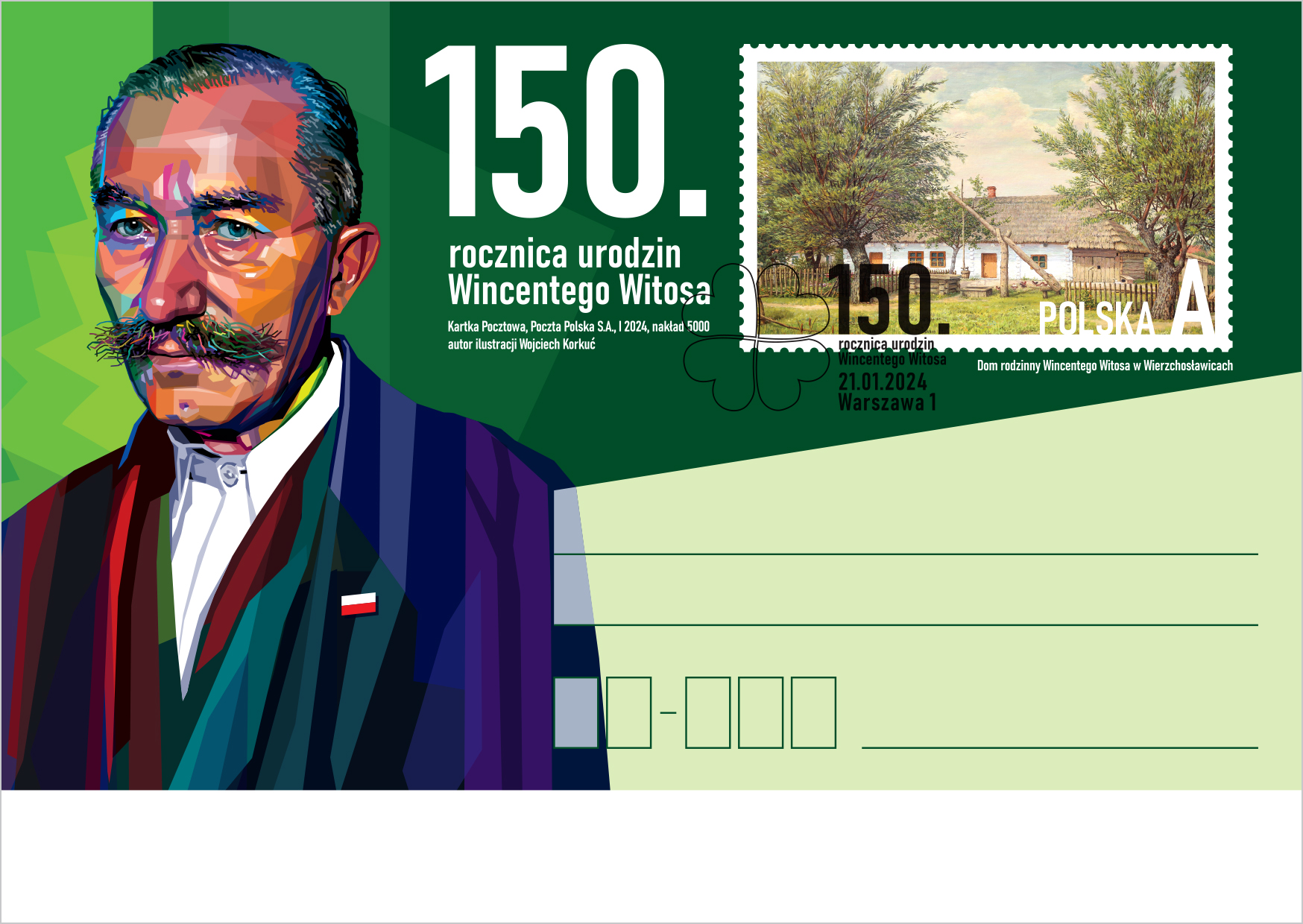
Wincenty Witos honored on a special postcard
 Wincenty Witos is considered one of the most distinguished politicians of the Second Polish Republic. He was a statesman and one of the founding fathers of independent Poland. As a leader of the peasant movement, he became a symbol of the struggle for independence and social justice. The Sejm (lower house of parliament) designated 2024 as the Year of Wincenty Witos, and the Polish Post Office commemorates this extraordinary figure with a postcard issued "150th Anniversary of the Birth of Wincenty Witos."
The Museum of Independence in Warsaw sponsored the issue. The illustrative portion of the card, issued by Poczta Polska, features a portrait of Wincenty Witos in traditional peasant garb, with the Polish flag placed on his left lapel, close to his heart. This is a symbolic reflection of Witos's commitment to prioritizing the state over individual interests.
The postage stamp features a reproduction of a painting of Witos's family home, provided by the Wincenty Witos Museum in Wierzchosławice. The issue is accompanied by a commemorative date stamp featuring a four-leaf clover, which has accompanied the Polish People's Movement since 1931. It is one of the oldest political symbols of Polish political parties. The entire composition was created by Jan Konarzewski.
Wincenty Witos was born on January 21, 1874, in the village of Wierzchosławice near Tarnów. As a leader of the peasant movement, he served as chairman of the Polish Liquidation Commission in 1918, representing the Polish state authorities in Galicia.
His three terms as prime minister (1920–21, 1923, 1926) were pivotal in Polish history, particularly during the war with the Bolsheviks. It was then that he issued his famous appeal to the peasants, calling on them to support the country's defense.
After the May Coup of 1926, Witos resigned, fearing a threat to Poland from neighboring countries. Accused of attempting to overthrow the government, he was arrested in 1930, sentenced to eighteen months in prison, and imprisoned in the Brest Fortress. He was stripped of his civil rights and decorations, including the Order of the White Eagle awarded to him in 1920. In 1933, Witos emigrated, returning shortly before the outbreak of World War II. During the occupation, he consistently refused to collaborate with both the Germans and the Soviets. He died in Kraków in 1945.
About the card:
Designer: Jan Konarzewski
Number of pages: 1
Value: A
Printing technique: offset
Paper format: 148 x 105 mm
Date of circulation: January 21 Warsaw 1