
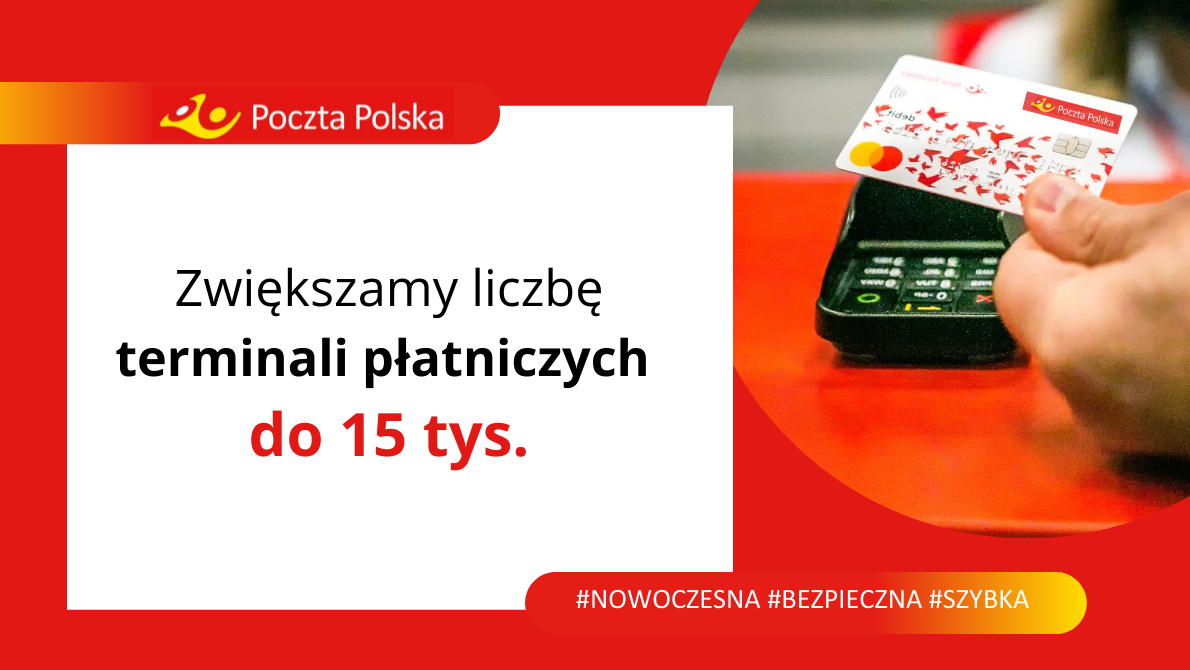
We are increasing the number of payment terminals to 15,000
 Poczta Polska is expanding its cashless payment offerings across its branch network. Currently, the company has 12,000 POS terminals. This expansion will be possible under a new agreement with the consortium of Bank Pocztowy SA, PKO Bank Polski, and eService Sp. z o.o. for cashless payment services. Poczta Polska customers are increasingly choosing to pay by card or BLIK.
The new agreement between Poczta Polska SA and the consortium, covering the next three years, will not only increase the number of POS terminals used by Poczta Polska SA from 12,000 to 15,000, but will also enable the launch of other modern payment solutions.
Poczta Polska (Polish Post) customers are making more and more cashless payments, both at post offices and with couriers. Over the first eight months of 2021, the number of card transactions increased by 14% compared to the same period in 2020. Meanwhile, the number of BLIK transactions increased by a staggering 115%. During the same period, the number of card payments to couriers also increased by 19%. The agreement concluded by Poczta Polska also allows for the implementation of new payment solutions. In September of this year, Multi MCC was launched, allowing convenient card or BLIK payments for Totalizator Sportowy products. In the future, payments requiring a separate MCC code will also be possible.
Poczta Polska currently has 8,500 POS terminals in 4,600 of its own branches, as well as 3,500 mobile POS terminals used by couriers. This constitutes the largest network of POS terminals managed by eService within a single entity. This makes Poczta Polska the largest customer served by the leader of the Polish payment services market.
eService is Poland's largest acquirer and a member of a consortium formed by PKO Bank Polski and Bank Pocztowy. For over five years, the institutions comprising it have been responsible for providing and managing payment solutions used by the Polish postal operator. Poczta Polska has been cooperating with the consortium since 2019.